What does Self-Adhered Really Mean?
Background of SAM’s / otherwise known as SAF (Self-Adhered Flashings)
- Highly utilized waterproof / water-resistant material that brings the advantages of adhesion to dry sheet goods.
- This material has evolved into becoming a staple within the construction industry, today widely used in all aspects of the building enclosure system.
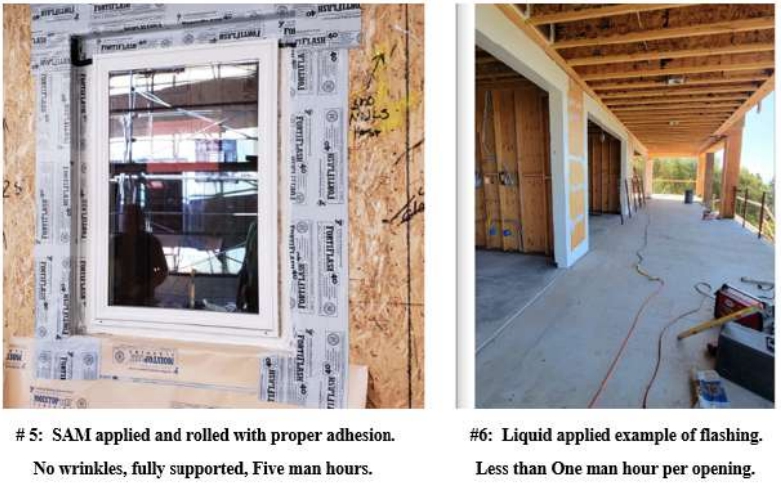
- SAMs are often mis-applied to the point where their performance and functionality (watertightness) is often compromised (wrinkles, inadequate substrate, lack of support and poor-to-no adhesion).
- The most important thing to remember is that unlike its name, (SAM) is anything but self-adhering (see pictures below).
4 EXAMPLES OF POOR INSTALLATION OF SAM
- #1 Lack of adhesion, no primer, not rolled
- #2 Wrinkles, voids, unsupported
- #3 No primer, poor adhesion
- #4 Unsupported, bridging air gap
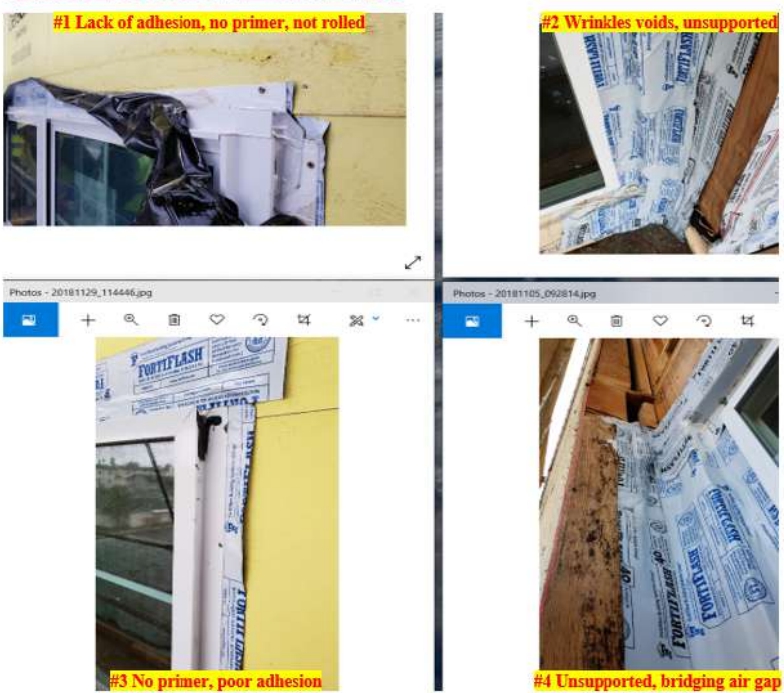
For the material (SAM’s) to function properly, it must be fully adhered. Some common mistakes that we have seen are shown in the four pictures on the previous page:
- Unsupported substrate (bridging air or gaps).
- Substrate is not recognized by the manufacturer. Substrate is too soft or too rough or chemically incompatible for adhesion.
- Rolling requirement step is often overlooked (via laminate roller), which would be a problem because the adhesive within the SAM is pressure activated.
- The substrates are often not a true plane — free of debris, dust, offsets, voids and gaps.
- Primer is often overlooked to perpetuate adhesion (specifically on porous substrates). Please note SAM may only be applied to primer during primer’s tack time (typically 5-to-15-minute window).
If and only WHEN the above aspects are correctly addressed, the (SAM) will then function to the performance of its water-resistant capacity.
A much more forgiving material that is starting to take over the self-adhered membrane applications are the liquid-applied applications of the equivalent and comparable sheet-good materials. The reason that liquid-applied is much more forgiving is because it is painted on and fully adheres without requiring a pressure-activated adhesive.
It is this firm’s opinion that the industry will progressively move toward more liquid-applied applications for waterproofing of the envelope and enclosure system rather than dry sheet goods and/or self-adhered membranes. Specifiers and Architects, consider upgrading complex geometry projects to liquid-applied application within the Division 7 Specifications.